
I. Why Flexible Cable Simulation?
The theme of "Made in China 2025" is to promote the innovation-driven development of the manufacturing industry, with the basic principles of quality and efficiency, green development, and talent-oriented, to achieve the transformation and upgrading of the manufacturing industry from large to strong; to accelerate the deep integration of new-generation information technology and the manufacturing industry as the main line, and to take intelligent manufacturing as the main direction; to comprehensively realize product intelligence, equipment intelligence, production intelligence, service intelligence, and management intelligence. The process of product intelligence and equipment intelligence is accompanied by richer functions and a smarter user experience, which means more complex electrical systems.
The difficulty of wiring harness development and pipeline design continues to increase. Unlike rigid structures, wiring harnesses and pipelines have flexible characteristics. Their deformation and stress states under the influence of external forces and their own gravity make it difficult to rely on experience to judge and determine. At the same time, these intricate wiring harnesses and pipelines are also required to be completed in a more limited space, and new and old problems and contradictions continue to emerge. poses a greater challenge to the development of traditional wiring harnesses.
II. Challenges faced by traditional wiring harness development
Traditional wiring harness development usually uses CAD software to arrange the direction of the wiring harness, and manufactures physical prototypes for experimental verification of the wiring harness, resulting in long R&D cycle, low efficiency, high cost, and inability to adapt to the speed of product upgrading and market demand.
Figure Traditional wiring harness development process
Due to the failure of the CAD software to fully consider the material stiffness of the wiring harness itself, the torsion situation and the influence of gravity on its direction, there is a huge difference between the CAD design direction and the actual direction, and the actual line length cannot be accurately estimated;
- It is impossible to accurately predict the small dynamic gap, small bending radius, large end pull force, stress distribution, torsion, dynamic envelope and other dynamic performance of the wiring harness;
- The influence of manufacturing tolerances and installation tolerances on actual installation cannot be simulated during design;
- It is not possible to accurately predict the impact of the clamp on the wiring harness on the installation at the time of design
- Real-time optimization is not possible;
Figure 2 Automotive electrical system
III. IPS Cable Simulation Solution
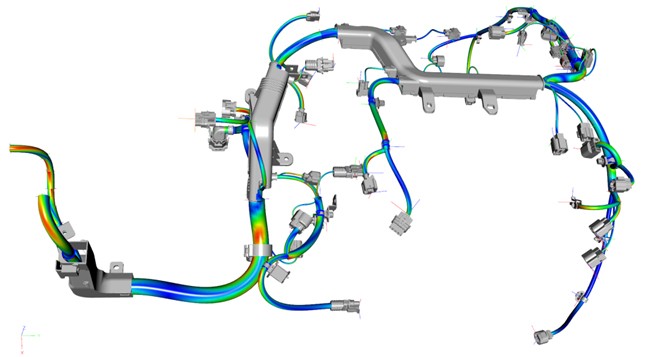
IPS Cable Simulation is a module dedicated to the optimization of flexible pipeline analysis in the Industrial Path Solution (IPS) software platform of fleXstructures GmbH in Germany. It is a flagship software product jointly researched and developed by ITWM and FCC, two research institutions specializing in digital simulation engineering algorithms in the European applied research organization Fraunhofer Research.
IPS Cable Simulation has been widely used in the design optimization and quality control of hoses, cables and complex wiring harnesses in industry, especially in the automotive, military and aviation fields.
Figure 3 IPS Cable Simulation
IPS Cable Simulation can simulate the flexible movement path of the pipeline under the condition of external force and gravity; it can simulate the pipeline of the moving part in real time, dynamically display the spatial deformation, bending state and stress and strain distribution of the pipeline; it can perform high-frequency vibration and fatigue analysis, tolerance analysis, sweep volume model, and generate the movement path envelope and tolerance envelope; real-time optimization and modification, the optimized data can be returned to the three-dimensional software, supporting data bridging with the three-dimensional software, and the pipeline can be automatically arranged according to the design rules.
IPS flexible cable simulation is applied to the three stages of wiring harness development: the design stage, the verification stage, and the assembly stage.
Figure 5 Application flow
3.1 Design phase
Relying on experience to design the wiring harness system in CAD software, but the influence of real material stiffness and gravity is not fully considered. At the same time, once the design of the surrounding digital model is changed, all directions need to be redesigned.
- Automatically arrange the direction of the wiring harness;
- Real-time interactive change of direction;
- Early prediction of risks;
- Mounting space monitoring of moving parts;
- Tolerance, clearance and motion analysis;
Figure 6 Design optimization
3.2 Verification Phase
Early verification can reduce the number of physical prototypes, thereby saving time and cost. Using IPS for virtual verification, not only can risk factors such as tensile force, small bending radius and dynamic gap be monitored in real time, but also can be optimized in real time according to the monitoring results.
- Real-time simulation based on real physical environment;
- Real-time monitoring of risk factors such as bending radius, torsion, stretching and dynamic clearance;
- Tolerance analysis can be introduced;
- Envelope calculation;
Figure 7 Validation analysis
3.3 Assembly Stage
The assembly of flexible parts such as wiring harness systems is a challenge, not only because of the narrow living space, but also the need to consider sufficient installation space, and the need to reserve a suitable length to ensure that the installation process and there is no risk after installation.
- Analyze the stress of the wiring harness during and after installation;
- Structural verification based on assembly analysis;
- Interaction optimization, real-time change of wiring harness length, material and clamp type;
Figure 8 Virtual assembly
IV. V + R Immersive Verification Experience
TechViz provides professional 3D virtual reality visualization collaboration solutions and in-depth cooperation with the IPS software platform. Combined with IPS, TechViz can provide users with an immersive verification experience.
- Support any display device, including HMD, cave, flat, tiled, ball screen, passive/active/autostereoscopic, multi-display, etc.;
- 1: 1 immersive stereo review of IPS data directly, without data conversion or import/export operations;
- Displays the data in IPS in real time, and can be synchronized to an immersive environment immediately after modification in IPS;
- Intuitive user interface, simple operation, low learning cost;
- High Frame Rate Display Extra Large 3D CAD Model;
V. Value of Flexible Cable Simulation
The wiring harness development process is a multi-party, multi-disciplinary and complex process. From the formulation of research and development needs to the production, manufacturing and testing of products, it will go through multiple stages and multiple iterations. The introduction of flexible cable simulation verification in the harness development stage can not only identify and eliminate potential design problems early, but also eliminate them before they occur, blocking the transmission of these problems to the downstream process, thus avoiding greater losses. At the same time, it can also help designers optimize design results, screen better solutions, shorten the iterative process of design results, and improve design efficiency and accuracy.
- Reducing the number of physical experiments in a digitalized world;
- Auxiliary acquisition cable correct installation length and design space;
- Assist in finding the correct arrangement before the physical prototype is manufactured;