
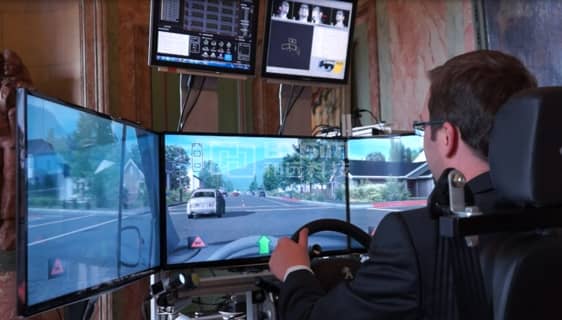
With the continuous deepening of the new four modernizations of automobiles, the intelligent cockpit, as the core carrier and important platform for realizing the "third living space" of automobiles, has become an important decision-making basis for users to purchase automotive products. In today's increasingly homogeneous phenomenon of automotive products, multi-modal interaction design based on user experience perspective has become a necessary question for differentiated design of automotive products, and has been paid more and more attention by host factories.
At present, the intelligent cockpit has shown a trend of scenario-based design. With different scenarios and multi-modal interactions inside and outside the vehicle, multiple scenario interactions can be realized to meet user needs. Therefore, after the virtual interaction verification means gradually matured under the static conditions of the vehicle, the demand for virtual verification under dynamic conditions came into being.
With simulated driving software, we can customize a variety of virtual environments and traffic scenarios to build the foundation for dynamic validation requirements. After satisfying the basic dynamic vision verification, users can also interact with the HMI design results at various stages of research to evaluate key indicators such as the convenience, friendliness, and clarity of information presentation of the control interface. Through various software and hardware protocols, users can simulate the multi-modal interaction logic in various scenarios and events, so as to find design problems early and improve them in time, which helps the host factory to shorten the R&D cycle, save R&D expenses, and provide users with a smarter user experience. And far intelligent cockpit dynamic simulation driving solution combines the above requirements, and far technology launched the intelligent cockpit dynamic simulation driving system. The system consists of SCANeR Studio virtual simulation platform, flexible gantry, optical tracking equipment, stereoscopic glasses, eye tracker, XR headset, ECG/PEC/EMG devices, etc.
SCANeR virtual simulation platform: provides comprehensive vehicle dynamics simulation, traffic scene simulation, sensor simulation and other functions to provide basic driving environment and event scenarios for driving simulation.
Flexible bench: A variety of models of human-machine hardpoint positions are flexible and adjustable, which can be combined with a six-degree-of-freedom sports chassis to work together with the SCANeR platform to effectively improve the simulated driving experience.
Optical capture equipment: high-precision grasping of the driver's movements, driving the virtual person and presenting the human-computer comfort effect in real time, and exporting data can calculate and output objective regulatory reports.
3D stereoscopic display: Using advanced 3D stereoscopic display technology, the virtual driving scene is presented as a more realistic and stereoscopic picture, enhancing scene perception and immersion.
Stereoscopic glasses: Equipped with high-quality stereoscopic glasses, allowing the driver to feel the depth and stereoscopic feeling of the virtual driving scene more clearly and realistically.
Eye tracker: Tracks the driver's eye movements in real time to accurately record their line of sight and gaze points. It helps analyze the driver's attention distribution, provides key HMI optimization data, and also provides important clues for intelligent cockpit design, ensuring that the driver can focus on key information while driving, thus improving safety and user experience.
XR Headset: Virtual Reality/Mixed Reality with XR Headset to immerse the driver in highly realistic virtual driving scenarios. This not only enhances the authenticity of the driving simulation, but also enhances the user's interaction with the virtual environment. By improving the user experience, the XR headset becomes a key device driving the continuous development of driving simulation technology.
Physiological information collection and analysis: The physiological information collection and analysis system is committed to real-time monitoring of the driver's physiological state, including heart rate, skin electrical activity and other indicators. Through these physiological parameters, the system is able to obtain a more comprehensive understanding of the driver's physical condition and emotional state, providing real-time data support for driver condition monitoring.
The flexibility and customizability of the system makes it suitable for a variety of test requirements, from the cockpit layout to the design of the interactive interface, the system can provide a comprehensive and accurate virtual environment to support the simulation of a variety of cockpit scenarios. This feature makes the system not only suitable for automobile manufacturers, but also provides a variety of application scenarios for research institutions and cockpit design teams, promoting continuous innovation and improvement of intelligent cockpit technology. With hypocrisy, steady and far-reaching
Through the forward-looking integration of technology, this dynamic analog driving system provides automotive manufacturers with an advanced and comprehensive driving simulation environment, bringing new standards and efficiencies to automotive design and testing. The real-time feedback mechanism of the system not only improves the authenticity of the test, but also injects vitality into the development of the intelligent cockpit. The cockpit designer can observe the driver's interaction behavior in different scenarios in real time and better understand the user experience, so as to optimize the interface design and interaction mode of the intelligent cockpit and ensure that users can obtain better comfort and operation convenience during driving.
The flexibility and sophistication of the intelligent cockpit dynamic simulation driving system allows it to adapt to the changing needs of automotive design and cockpit technology. At the same time, through real-time feedback data, manufacturers can adjust and optimize vehicle performance more quickly, providing users with a smarter and more personalized driving and cockpit experience. This trend is helping automotive manufacturers better meet user expectations in the fierce market competition, driving continuous innovation in the entire field of intelligent cockpits.